An SEO content brief should tell the writer what the page must do, and what it must not invent.

An SEO content brief is the document a writer works from before the first sentence exists. It names the query the page targets, what the page has to do for the person who typed it, and where the facts come from. A brief that settles those three things before the writing starts saves the rewrite that happens when they get settled afterward.

Querywright issues a brief of its own at the Generate step, after a human has approved the direction. This page is about what belongs in a brief, and what Querywright puts in one.

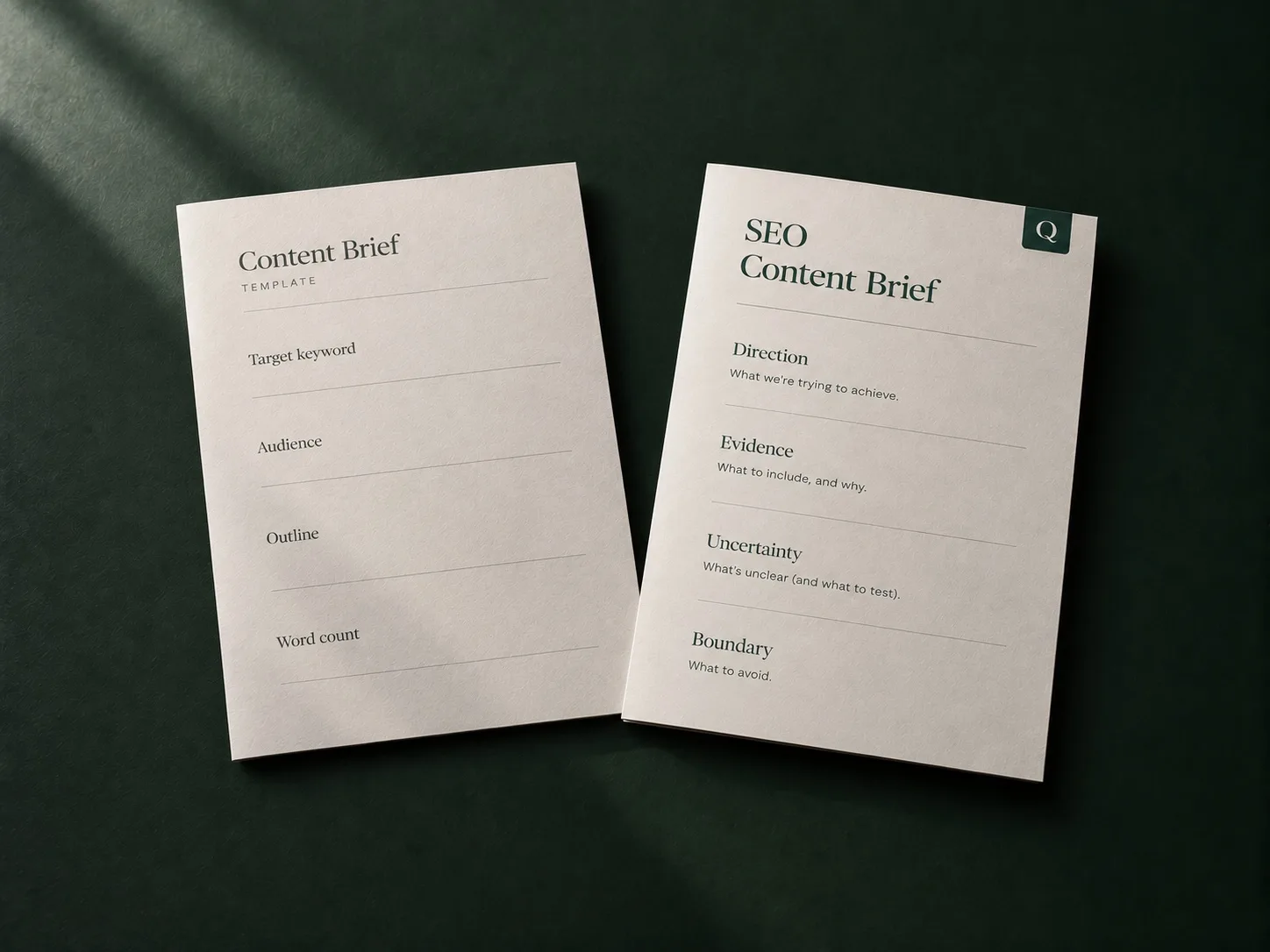
Two documents side by side: a content brief template with empty fields for target keyword, audience, outline, and word count, and a Querywright SEO content brief with sections for direction, evidence, uncertainty, and boundary.

What a good SEO content brief contains.

  1. 01

    The direction.

    One primary query, the page that owns it, and any supporting queries that belong on the same page. If two pages are chasing the same query, the brief should say which one wins.

  2. 02

    The evidence.

    What is actually on the site today, and what a provider measured for the queries in question. A brief written from memory of the site drifts from the site.

  3. 03

    The uncertainty.

    What a searcher might expect from the query that the page cannot honestly promise. Writing this down is what stops the copy from promising it anyway.

  4. 04

    The boundary.

    The facts the writer must not invent: figures, credentials, capabilities, anything the evidence does not establish. A brief that leaves this out gets copy that sounds complete and is not.

Querywright’s brief carries all four: the approved direction, the retained evidence, explicit uncertainty where the evidence runs out, and the facts the writer must not invent.

A template gives you the headings. It cannot tell you whether the page should exist.

An SEO content brief template is a form to fill in: target keyword, audience, outline, word count. It is useful for keeping briefs consistent across a team. It has no opinion about whether the keyword in the first row was measured or guessed, or whether another page already owns it.

Querywright does not offer a template. Its brief is produced against research that was retained, so the keyword and page direction are grounded in measured demand and an approved strategy, not invented at drafting time.
A content brief generator starts from a keyword. Querywright’s brief starts from a decision.

A content brief generator takes a keyword and produces an outline. That is the right tool when the keyword is already settled and the outline is the missing piece.

Querywright’s brief comes later in the chain. Your AI proposes which page should target which query and says why. You approve the direction, or you don’t. Only then does the brief exist, and it carries the approval with it. The writer is never asked to guess what was decided.

Where the brief sits in the chain.

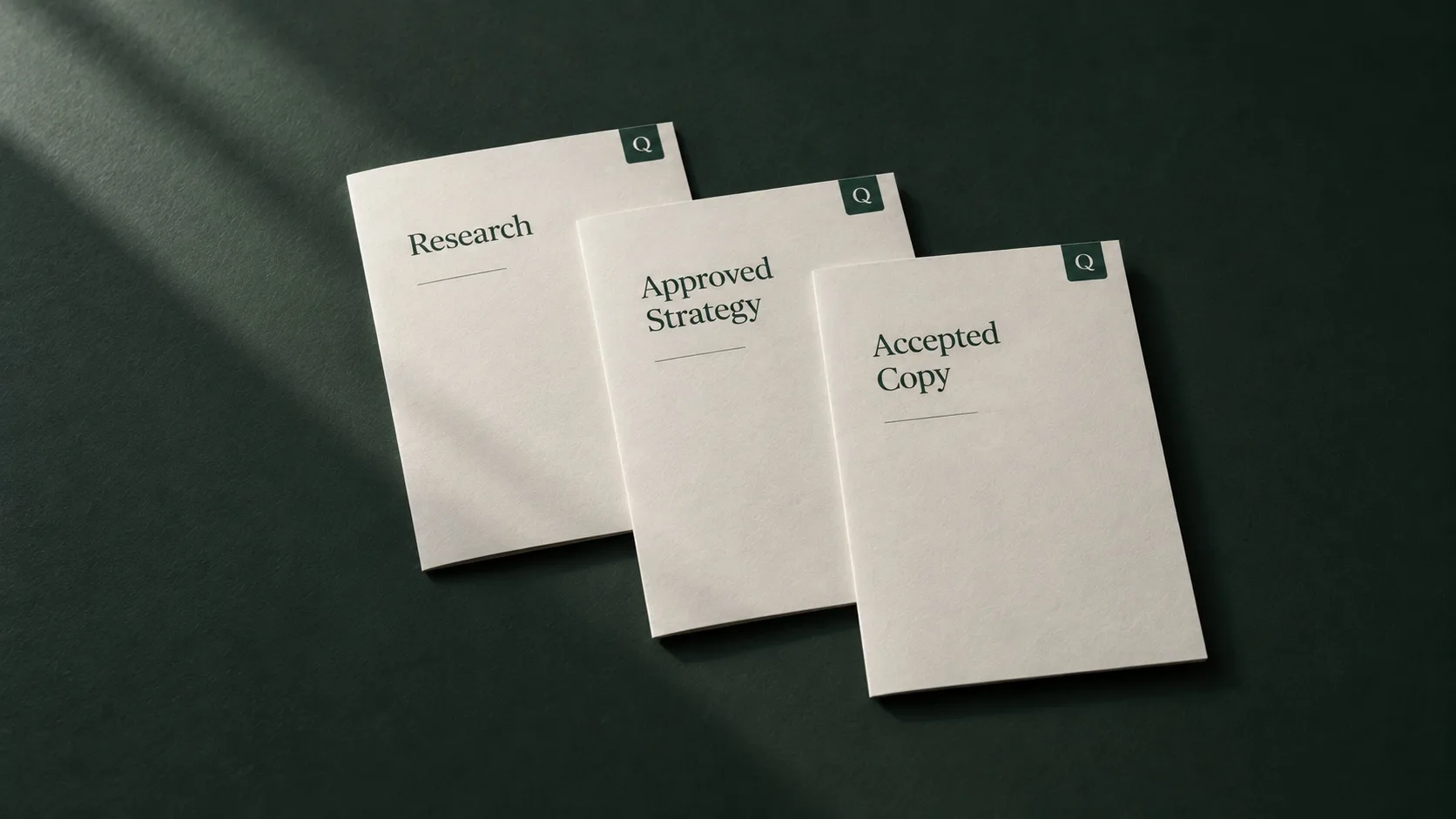
Research comes first: bounded and persisted, so you see what is actually on the site before anyone proposes changing it. Demand is measured by a provider, and measured positive, measured zero, missing provider evidence, and unmeasured stay different things. Your AI proposes. You approve. Then the brief is issued, your AI writes from it, and you accept the work, revise it, or reject it. Before anything ships, the accepted copy is checked against the approved strategy and the retained evidence.

The brief is step five of seven. Everything before it is what makes the brief trustworthy. Everything after it is what keeps the writer honest.

Three Querywright booklets laid in sequence: Research, Approved Strategy, Accepted Copy.

Bring the AI you already use.

Your connected AI does the reasoning and the prose. Querywright keeps the evidence, the measurements, and the decisions durable around it, so the writer gets an authenticated brief instead of reconstructed chat memory.

Research, approved strategy, accepted copy, and verification results persist beyond one AI conversation. The decision and evidence behind last month’s brief do not disappear with the conversation.

Write from evidence, not from a keyword.

Find the demand. Choose the page. Approve the strategy. Generate from the brief. Keep the work.

Join Founding Beta