Core concepts
Evidence vs your AI's judgment
Querywright keeps the facts. Your AI does the thinking. You make the decisions. Every record says which of the three it is, so a recommendation never passes for evidence.
Three parties share the work. Querywright scans your site, measures search demand, observes Google’s results, saves every record and runs mechanical checks. Your AI (Claude or ChatGPT) reads that evidence, reasons about it, recommends a direction and writes the copy. You approve the plan, accept the copy and make the other decisions. Querywright stores your AI’s reasoning beside the evidence, but storing it never turns it into evidence.
What Querywright records
Each statement in the record belongs to one of five kinds.
| Label | Who | What it means |
|---|---|---|
| Observed | Querywright | Querywright saw this, on a date: on your site in a scan, in Google’s results, on a competitor page, in a link snapshot, or in what Google reports through Search Console and Analytics. |
| Measured | Google Ads, through Querywright | A provider measured this, in a named location and language, on a date. Search demand is the main example. |
| Reasoned | Your AI | Your AI concluded or recommended this: which page should own a search, why a plan makes sense, what a competitor’s page suggests, the copy itself. |
| Approved | You | You chose this: a plan, an exact version of the copy, a statement you confirmed, a direction you are not pursuing. |
| Checked | Querywright | Querywright checked the copy you accepted against the approved plan and the saved evidence, mechanically. See checks. |
An observation of your site records what the site said on that date. It proves what was there, not that it is true. A statement on your About page is your site’s statement, and Querywright keeps it as that.
How your AI should label what it tells you
Expect your AI to separate four kinds of statement in a recommendation:
- a Querywright fact, which it can point to in a saved record
- a provider estimate, with the provider and the date
- its own read, said as its own
- what is unknown
A cause, a claim that something is “winnable”, or “the best move” is always your AI’s read. A good answer gives the evidence it rests on, the option it set aside, and what would change its mind. If your AI states a number without saying where it came from, ask.
For each recommendation you just made, tell me which parts come from Querywright’s saved evidence, which are Google Ads measurements, and which are your own read.Who acts: You, Your AI, Querywright
Lists of next steps in the App tag each step with who takes it:
| Tag | Meaning |
|---|---|
| You | A decision only you make. Your AI asks you and records your answer. |
| Your AI | Work your AI does in Claude or ChatGPT: reading evidence, writing, asking Querywright for a check. |
| Querywright | Something Querywright does on its own schedule, such as a weekly rank check or an import from Google. |
The App describes these lists as “Valid steps in workflow order, with who takes each. Not a recommendation.” A step tagged You is waiting on you; it is not advice to say yes.
Sequence is not cause
Performance, History and the page record show dated facts in order: the copy was accepted, the page was published, the ranking moved, clicks rose. The order is real and worth knowing. It does not establish that the change caused the rise. Google updates, competitors, seasons and demand move the same numbers. The App says it plainly: “Changes show what happened, not why.”
The same rule covers the other things Querywright observes:
- A Search Console impression is exposure: Google showed your page. It is not search demand, and an average position is not a rank check.
- A first ranking observation is the first thing Querywright saw, not a baseline. Before it, the prior state is unknown.
- “Approved copy is live” means Querywright’s comparison found your accepted copy on the live page. It says nothing about Google’s index. Google’s index line is Google’s own dated report.
- A link that appears after you decide to pursue a source is a dated fact, not a result.
Where it shows in the App
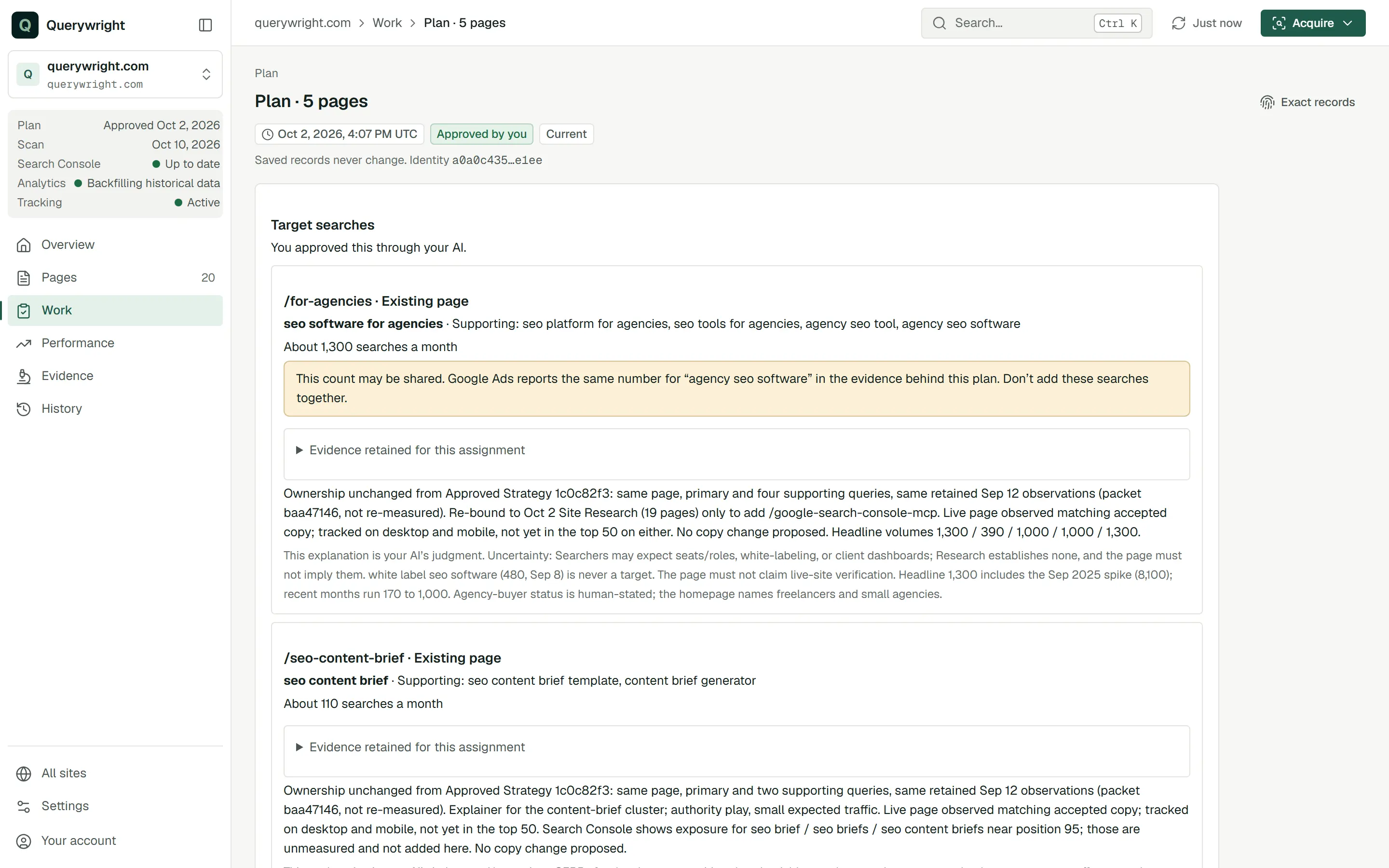
A saved plan shows each target search with its measurement, then your AI’s rationale, labelled “This explanation is your AI’s judgment.” Any uncertainty your AI stated stays with it. The evidence behind a view opens from Exact records, which names the saved records by identity and gives you a request to copy into your AI so it can open the same ones.
Does it use allowance?
No. Reading saved evidence, asking your AI to separate fact from opinion and opening Exact records use none of your included allowances.
Last updated